Beyond the “Stiff Suit”: The Surprising Science and 2026 Trends of the Modern Business Headshot
1. Introduction: The 100-Millisecond Handshake
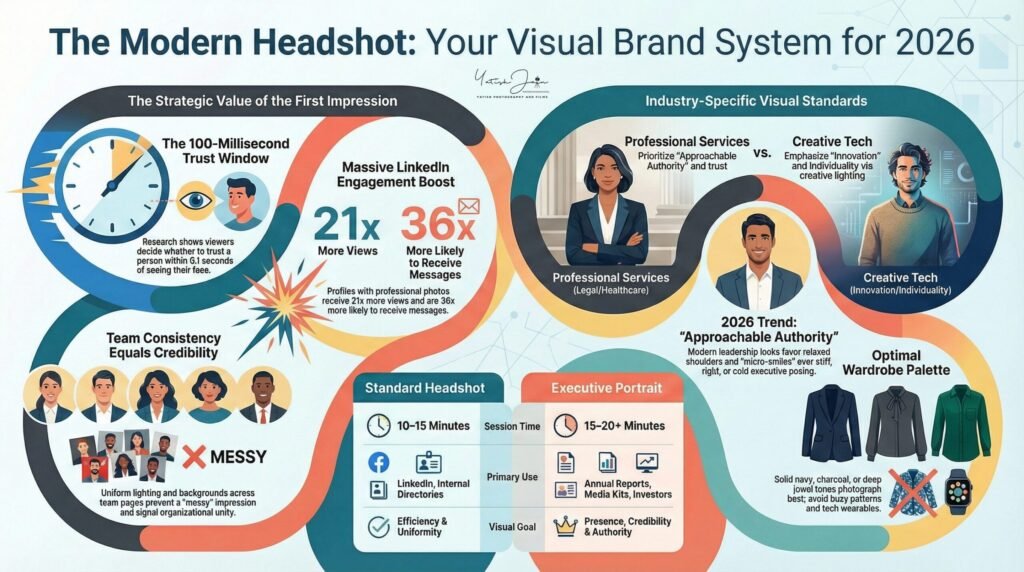
In a digital-first economy, your first handshake rarely happens in a boardroom. It happens on a LinkedIn feed, a Zoom thumbnail, or a high-stakes investor deck. This digital introduction is nearly instantaneous: research confirms that the human brain decides whether to trust a person within 100 milliseconds of seeing their face.
As a strategic branding consultant, I advise leaders that a headshot is no longer just a profile picture—it is a high-performance “brand asset” and the “visual logo” of your personal brand. In 2026, investing in a professional portrait is not a vanity project; it is a calculated financial decision designed to influence decision-makers and communicate credibility before you even speak. If you aren’t treating your image as a scalable corporate asset, you are already losing ground to those who do.
2. Takeaway 1: Your Brain Decides to Trust in a Blinking of an Eye
Visual data carries a weight that text simply cannot match. Humans recall 65% of visual content three days after exposure, compared to a meager 10% for written text. This disparity turns your headshot into the primary driver of your professional reputation.
A “bad” headshot—a low-resolution selfie, a grainy crop from a wedding photo, or a dated shot where “Aunt Carol’s” arm is still visible—functions as a “quiet credibility leak.” It signals a lack of attention to detail and professional apathy. In 2026, your digital presence is your “trust page”; any inconsistency here subconsciously encourages potential clients to look elsewhere.
“The research showed that you make your decision to trust someone within 100 milliseconds of seeing their face.” —
Adam Jacobs, Cognition and Emotion Journal
3. Takeaway 2: “Approachable Authority” is the 2026 Power Move
The era of the “Executive Statue”—characterized by rigid shoulders, generic gray backdrops, and a forced, tight-lipped grimace—is obsolete. Modern leadership requires “approachable authority.” Smart leaders are pivoting toward images that feel human and relational, signaling that they are both highly capable and easy to talk to.
To achieve this, 2026’s top-tier strategists employ specific posing micro-adjustments:
- The Slight Forward Lean: This is the ultimate engagement tactic. It signals that you are “leaning in” to the conversation, transforming a static image into a dynamic representation of capability.
- Relaxed Geometry: Shoulders remain loose, and the chin stays neutral rather than lifted (which can appear arrogant) or tucked (which signals insecurity).
- Micro-Smiles: A genuine, friendly neutral expression replaces the stiff corporate mask, projecting warmth without sacrificing power.
4. Takeaway 3: The “Triangle of Space” and the Geometry of Confidence
Professional posing is an exercise in engineering. One of the most critical technical adjustments for a flattering silhouette is the “Triangle of Space.” By placing hands on hips or in pockets, you create a visible gap between your arms and your torso.
This separation is vital because arms pressed against the sides widen the subject’s silhouette. Creating that “triangle” defines your frame and projects a more confident, streamlined image. Whether you are using a traditional suit or a creative layers approach, this geometric gap is what separates a polished brand asset from a casual snapshot.
5. Takeaway 4: Technical Hacks for the Modern Asset: From 2x Lenses to Cowboy Framing
High-level personal branding requires technical precision. If you are forced to use a smartphone for a quick update, never use the standard wide-angle lens. Acclaimed photographers note that the
2x telephoto lens is the only choice for headshots, as it avoids the unflattering facial distortion common with wider lenses.
Furthermore, we are seeing a major 2026 trend in “Cowboy Framing.” By shooting from just above the knees up, photographers provide more environmental context and make the subject appear taller—a move frequently used in editorial portraits for major publications.
Finally, remove the tech wearables. While an Apple Watch is a daily staple, it is a “timelessness” killer. Tech ages rapidly; a smartwatch today becomes a date stamp in two years. To preserve the longevity of your investment, stick to a traditional timepiece or a bare wrist.
6. Takeaway 5: The “Uncanny Valley” – Authenticity as a Luxury Status Symbol
As AI-generated headshots flood the market, “authentic presence” has emerged as a high-value status symbol. AI tools often fall into the “uncanny valley,” producing images that feel “off” due to mismatched details or “too perfect” rendering.
In 2026, real texture is a trust indicator. This is why we advocate for
“invisible retouching.” The goal is to look polished and refreshed, but the skin must retain its natural texture—pores, fine lines, and unique details. Over-smoothed skin looks plastic and signals a lack of authenticity.
“AI headshots are everywhere—and that’s making real headshots more valuable… a professionally made headshot captures what companies actually want in 2026—authentic presence, polished quality, and repeatable consistency at scale.” —
Corporate Headshots in 2026
7. Takeaway 6: Color Theory and Industry-Specific Narratives
Strategic wardrobe and background choices are essential to minimize “decision fatigue”—the same psychological drain that leads leaders like Mark Zuckerberg to adopt a uniform. However, your “uniform” must be strategically aligned with your industry’s specific narrative:
- The Legal Sector: To balance authority with accessibility, lawyers should opt for hand-painted canvases or muted backdrops.
- The Industrial Sector: Professionals in manufacturing or construction should use “in-situ” (on-site) headshots with subtly blurred machinery in the background to signal boots-on-the-ground expertise.
- The Creative Industry: This sector demands individuality. Experimental lighting and bold color choices against high-contrast backgrounds reflect an innovative brand.
8. Conclusion: The Future of the First Impression
In 2026, a headshot is a
Visual System, not a one-off photo. It must be scalable, requiring standardized crop sets—from the LinkedIn circle to wide website banners and press kit thumbnails.
For organizations, team consistency is no longer optional. Mismatched lighting, random crops, and varying color casts on an “About Us” page create a “credibility leak” for the entire company. A unified visual system signals an organization that is organized, professional, and excellent in every detail.
If your headshot is your first handshake, is your current one leaning in with authority, or is it backing away in a blur of pixels and poor choices?